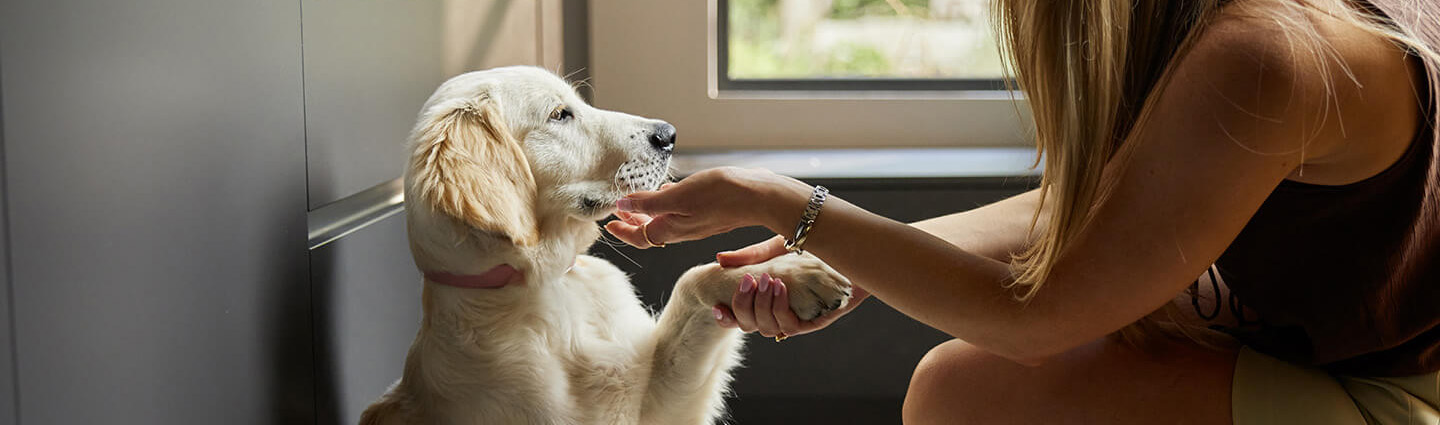
It is a pleasure to live with a well-trained dog. No jumping up, pulling on the lead, does come back when called, not stealing the dinner, toileting in the right place: training your dog makes life less stressful. Having a well-behaved dog also means that you do more with them: they can accompany you to more places without you worrying about their behaviour when out.
There are many different training methods talked about online or on TV, but which of these methods is best for your pet?
Positive reinforcement is the act of rewarding your dog when they do what you ask them. The reward used can be food, a toy that is kept for training only so is very exciting, or affection and praise, depending on the likes and dislikes of your dog. Dogs become more engaged with training and learn quicker if the training is reward based. It is the advised method of training your dog.
The benefits of positive reinforcement or reward training include building a stronger bond between you and your dog. Your dog wants to learn and to please you and there are less behavioural problems reported than with other training methods. Reward trained dogs also become more confident and so tolerate and enjoy going to new places and meeting new people and animals.
When using a positive reinforcement method, there is no positive punishment (for example physical correction/smack) for an incorrect behaviour, just gentle, calm, quiet and patient repetition of the training. If you do catch your dog doing something they shouldn’t be, using the single word ‘No’ in a firm but calm voice, then distracting your dog with a toy, say, as soon as they stop, means that your dog is corrected in a way that causes no distress or discomfort.
Correction can only be done if you catch your dog ‘in the act’ as your dog cannot link correction to a behaviour or action that happened before, they only link it to what is happening now. So, if your dog is sitting quietly on the floor when you get in and is then admonished for destroying your slippers while you were out, they think they are being punished for sitting quietly.
Clickers can be bought in store – when the button is depressed a sharp click sound is emitted. Dogs need training to the clicker before you can start training, so in a quiet place with few distractions, use the clicker once and reward your dog if they turn or look at you. Most dogs learn very quickly that a click means reward and then you can move onto using it to assist with training. When training your dog to come, for example, call your dog from a very short distance away, and if they turn or move towards you, click and reward. Widen the distance and do it again. If your dog does not respond, then try again later, or reinforce the initial clicker training. Remember that one click only is needed, don’t just click continuously if your dog is not responding as this will dull their reaction to the sound.
Getting the timing right is vital – the click must be done during or very shortly after the correct behaviour or action is performed. If that short window is missed, the dog will not know what the click relates to, and training will be ineffective.
Many trainers use clicker training, so if help is needed on their use, find a qualified trainer local to you who uses this method.
Electronic training is a form of positive punishment training as it corrects the dog with an uncomfortable sensation. It is used so that the dog associates an incorrect behaviour or action with a negative sensation.
Shock collars are banned in Wales, are being banned in England, are advised against in Scotland and have no restrictions in Northern Ireland. They work by giving the dog an electric or static shock when the owner presses the button on a handheld controller. Using these collars needs proper training, as incorrect use punishes the dog at the wrong time, while irresponsible use – pressing the button to see the dog's response, say – is just cruel.
Collars that spray the dog are not painful, but research has shown that the levels of stress (shown by the level of cortisol in the blood) is the same for spray collars as for shock collars. There are also questions about reliability and false triggering by head shaking, vigorous exercise or even heavy panting – any deterrent needs to work at the correct time every time. Spray collars are normally used to prevent barking – this is usually when the owner is not present, so there is nobody to check on the wellbeing of the dog while the collar is on. It has also been shown that there is no learning from the use of a spray collar, and behaviour reverts to previous levels of barking if the collar is not used for a few days.
It is also known that dogs trained with shock or other collars, suffer from higher levels of adverse behaviours than dogs trained with positive reinforcement. Higher levels of anxiety, aggression and fear are seen in dogs that have been wearing these collars.
Given that these collars do not appear to give lasting results even when used correctly, that there are increased stress levels associated with their use and that there is an increase in adverse behavioural changes, it is advised to use a positive reinforcement method of training instead of positive punishment.
Classical conditioning is when your dog learns that one stimulus means that something is about to happen and then reacts appropriately. The stimulus and its consequence must happen regularly and close together, then the dog will learn what to expect.
So, if your dog suddenly gets excited when you put on your dog-walking coat, it is because they have learned that this means that a walk is going to happen. This is a positive reaction as your dog enjoys going out.
Another example of classical conditioning is when you have your dog in the car and turn into the road of your veterinary practice. Your dog gets unsettled and a little nervous as it knows where it is going. This is a negative classical conditioning response (though of course, some dogs love the vets and get excited, giving a positive response).
This response is not driven by the owner or even consciously learned by the dog and is an involuntary learning experience. Classical conditioning alters the dog's unconscious reactions and can be used in dog training by pairing something the dog doesn’t like with something they do. For example, if your dog doesn’t like being in the car, feeding him treats in a stationary car will link a good experience with the car and will, as part of a training program, help to get them to feel more comfortable.
Classical conditioning can be used alongside positive reinforcement (or operant conditioning) in training. Combining the two methods can be tricky, so you could get help from a behaviouralist or trainer experienced in this technique.
The science-based training method makes use of Applied Behaviour Analysis. This means the studying of behaviour to help understand the causes and components of this behaviour. This allows the formulation of a plan to alter these components with training and so change the behaviour.
For example, if your dog jumps up at guests, you need to break this behaviour into the trigger, the action and the consequence. The trigger is guests coming in, the action is your dog jumping up and the consequence is your dog being fussed by the guests. So, it is possible to change these steps to alter the behaviour.
The trigger can be changed by putting your dog on a lead when guests arrive, and the consequences changed by asking your guests not to engage with your dog until they are sitting quietly. You need to reward your dog when they perform the required behaviour. Repetition is important, then this will, over time, change the action of your dog getting over-excited and jumping up, until they stay calm when guests arrive.
Behaviourists who come to do one-on-one training in your house so they can observe your dog’s behaviour are following this reasoning. As well as taking a full history they will be watching what happens before, during and after the incorrect behaviour, then trying to understand the emotions and motivation for that behaviour. Then, they can advise you how to modify the trigger and the consequence to allow change of the action in the middle.
Mirror training relies upon the strong bond between owner and dog. The owner performs the required behaviour and then the dog copies or mirrors that behaviour and gets rewarded. Your dog learns by watching your behaviour and copying it.
This method works best if you are with your dog most of the time and they accompany you in your daily routine, then they will watch your behaviour and unconsciously mirror it in many different situations, not just in a training session.
The crate should be big enough for your dog to stand up, turn around and lay down comfortably and have enough room for a good bed. If you are buying a crate for a puppy, take into consideration the full-grown size of your dog.
Crates can help with toilet training, as dogs will not usually toilet where they are sleeping, and, if they are a suitable, in the car if you need to travel, giving your dog a safe place in which they are comfortable and relaxed on the journey.
Your dog's crate should be positioned somewhere quiet, away from high footfall areas such as hallways, so that they can relax and take time out without being disturbed. Remember that water should always be available, so use a clip-on water bowl inside the crate.
It is important to train your dog to use the crate, don’t just put them into it and shut the door. The crate should be somewhere your dog can go where they feel safe and comfortable and should never be used as a punishment.
The crate can be covered with a blanket to make it more appealing as a safe place, and the door must be secured open before training starts. Start off by dropping treats near the door of the crate and then, once your dog is comfortable being close to the crate, drop them through the roof onto the bed inside. Give verbal praise if your dog goes inside.
Some dogs will just leap in and settle down, but others may take longer to see the crate positively. Monitor your dog and if they do go into the crate and lay down, approach quietly and give them a treat or gentle verbal praise so they know that they have done well.
It is important not to close the door until your dog is very comfortable inside. Then you could put a long-lasting chew, or a food stuffed toy inside the crate and gently close the door without locking it. If your dog looks unsettled or anxious, then open the door and try again later. If your dog is settled, then you can extend the length of time inside the crate and then start locking the door for short periods while you are in the same room. Gradually increase the length of time with the door locked and then start leaving the room, for a few minutes initially and then longer as your dog gets used to you not being there. At any point, if your dog looks unsettled, open the door and try again the next day.
Puppy training is all about positive reinforcement or reward training, used little and often with lots of patience and negative punishment. Negative punishment means taking something away – so if your puppy gives you a nip, you take yourself away by turning your back or leaving the room – that isolation from you is the punishment for the pup. They will then associate nipping with the loss of your presence and learn that nipping is not a good thing to do.
It is important to have short training sessions regularly, as repetition will enable your pup to learn quicker. Training can be started as soon as you get your new puppy home, then you can start with the basics – coming to their name, sit, leave, no, go for a wee, bed etc.
Use reward training and offer suitable training treats or a toy every time your puppy performs the right action. Breaking down each required response into smaller actions will speed training as well.
To train your pup to come to you, for example, start by choosing a quiet place indoors, with few distractions. Have pup close and call their name. If your pup looks up at you, reward. Then move a bit further away, call their name and ‘come’ and reward again if pup looks at you or makes any move towards you. Increase the distance and repeat until pup comes straight to you reliably. Then you can consider moving into a busier room and then outside into the garden, where there are more distractions. Keep your chosen verbal command the same, just one or two words spoken with a cheerful voice, used every time you require that response.
The same procedure of breaking down a required response into little chunks can be applied to most of the things that you need your pup to learn. Patience and regular repetition are vital for consolidating the training. Once your puppy is performing the required response reliably, food treats can be reduced, and more toy and affection-based praise used instead. Also remember that training treats do add to the daily calories for your pup, so if you are doing a lot of training you may need to reduce their normal dog food a little to prevent your pup becoming overweight.
If you are struggling or not sure about how to train your puppy, puppy classes are very useful for teaching you the basics and for socialising your puppy with other dogs (also a vital part of the early learning that our puppy needs). Information on classes can be found online, through your vet or from other dog owners.
To train your dog to sit, offer a treat so that your dog has to lift their head to get it and say the word “Sit”. With a second treat, move your hand over the nose towards the tail and your dog should lower their bottom to get the treat. If your dog tries to turn and not dip to get the treat, you could try training in the gap between a sofa and the wall say, so that they cannot turn. Repeating this action will lead to your dog sitting to get the treat.
Practice will reinforce the training and once your dog has got it, you can reduce the food treats and replace with a toy, affection or verbal praise alone.
Remember that a vocal cue is needed every time and that the tone of the cue is important – it should be a firm but polite request, in that headmistress way that you would never ignore.
Classically, the herding (Border Collie, Bearded Collie) and guard breeds (German Shepherd, Dobermann) are easy to train with smaller terriers (Jack Russel, Wire haired Fox terrier) not so quick. The Poodle and Papillon also rate highly in the easy to train group. But every dog is different in character and the bond between dog and owner is also very important for learning.
Younger dogs learn quicker than older ones, so start training as early as possible. That doesn’t mean that older dogs cannot learn – it has been shown that training older dogs helps with their mental wellbeing, much the same as brain training helps older people.
If your dog is very easily distracted or over-excitable, then repetition and patience will be needed, and training may never be quite so firmly obeyed. Many of these dogs are very well trained until something catches their attention and then all training is forgotten. For example, in the park your dog is recalling well until a squirrel pops up in front of them, then all recall has gone.
If you have a good bond with your dog and are using a good technique, then training will generally work – it is just the speed and retention that may differ between breeds. Most trainers advise that no dog is untrainable, it is all about finding the method of training that works for your dog. If you do need help, then check online for a registered, qualified behaviouralist or trainer.
Guide dogs spend the first 12-15 months with puppy walkers, who use positive reinforcement to teach the basic commands, much as any other dog owner. Once working with the Gide Dog trainers, the basic commands are reinforced such as loose lead walking to heel and obedience.
The trainers then work on stopping at kerbs, moving forwards in a straight line and avoiding obstacles and working the dog with lots of distractions present.
Working in different environments is important, both rural and urban. The dogs must learn intelligent disobedience – knowing when not to go forward if there is a risk to the handler – from overhanging branches, oncoming traffic etc.
The training then involves more complex situations with busy streets and more distractions, and working with the client themselves, ensuring that the match of client and dog is a good one.
Older dogs can still be trained, and it has been shown to preserve their mental acuteness and keep some of their enthusiasm for life. Always use positive reinforcement and repetition, and choose the activity being trained carefully – make sure that your older dog can perform the required response before starting – if training tricks, choose those that can be done if your dog has osteoarthritis.
Aggression in dogs has many causes and the cause should be explored before training starts. A veterinary check is advised to rule out pain or underlying disease as a factor. If deemed healthy, the next step is to work with a qualified, registered behaviourist or trainer (look up APBT, APBC and CCAB).
Any signs of aggression, such as growling, lunging forwards is your dog already giving last resort signs and advice from a qualified person should be sought as early as possible. Subtle signs of discomfort or fear, such as cowering, yawning or lip licking in certain situations, wagging a stiff tail or turning away are early warnings that your dog is uncomfortable or worried and should not be ignored.
Owners should not attempt to retrain aggressive dogs without suitably qualified and experienced assistance, as incorrect training methods can make the situation much worse. The behaviouralist or trainer can work with the owner to find the causes of the dog's behaviour and plan an effective training schedule.
Rescue dogs can be the most loving dogs to own, but many do come with behavioural problems from their former life. The history of these dogs is often unknown, so understanding when and why these unwanted behaviours arose is difficult and retraining the dogs can take much time and effort. Many of these dogs suffer from anxiety and fearfulness, so gaining their trust so that training can be effective can take an extended period of time.
It is always advised to work with a qualified, registered, experienced behaviouralist or trainer right from the start. This avoids accidentally making the situation worse with well-meaning actions that do not suit the dog. Positive reinforcement training methods are always used with these dogs.