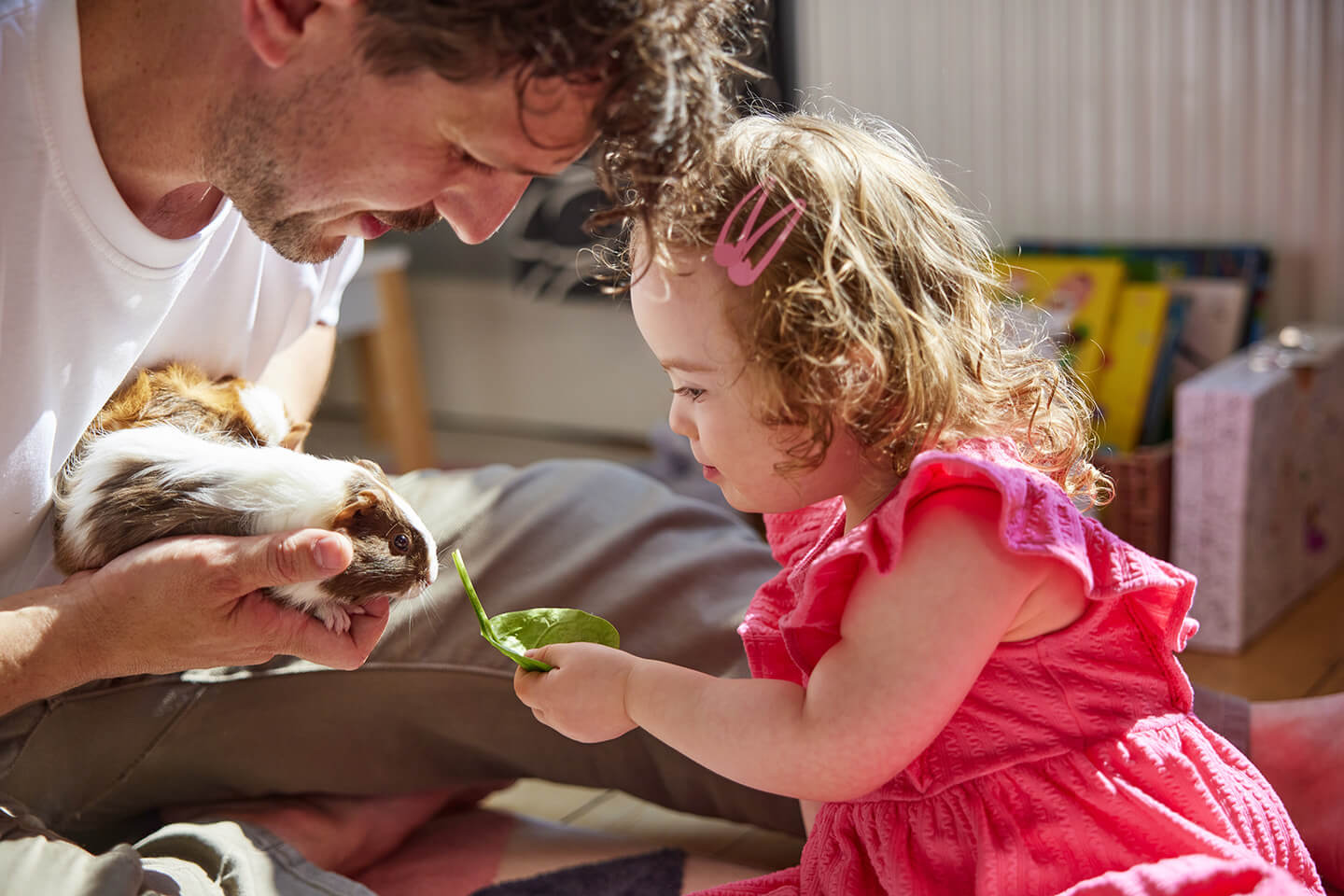
Guinea pigs can be good family pets. They are amusing and entertaining to watch, showing you how excited and happy they are with squeaks and squeals. While they don't usually enjoy being picked up, they are happy to be petted and stroked. They are relatively straight forward to look after, kept in single-sex pairs or groups and can be kept indoors.
Guinea pigs generally live for around 5-6 years, but the oldest one recorded was almost 15!
Guinea pigs should be kept in pairs or groups with other guinea pigs. Different species (such as guinea pigs and rabbits) should not be kept together, as different diets are needed, and their behaviours are very different, so fighting and injury can occur. Guinea pigs should be kept safe from cats and dogs, as a guinea pig’s response to threat is to run and fast movements can trigger a hunt response in some animals.
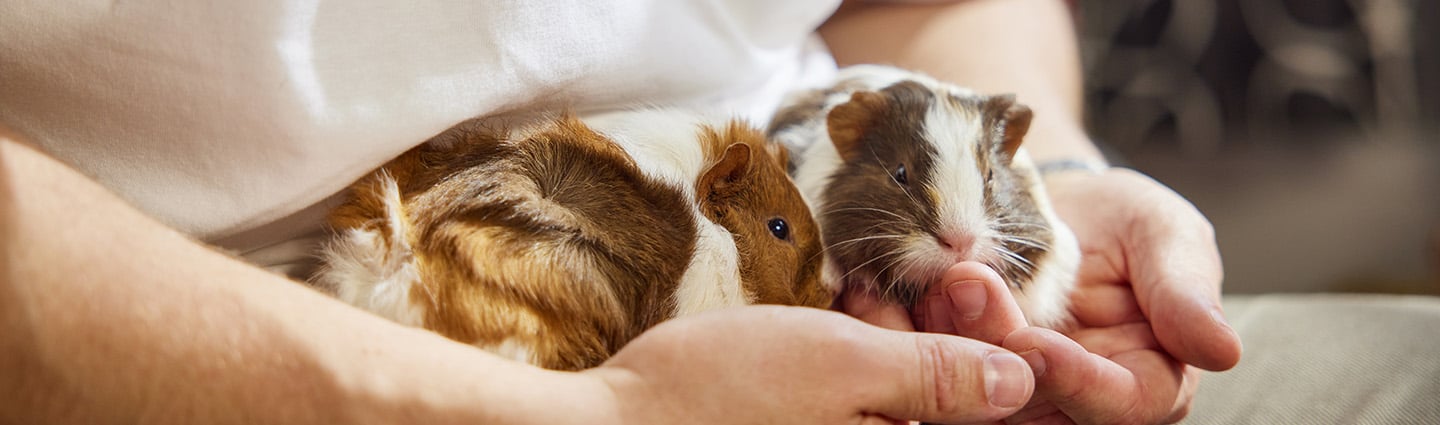
Guinea pigs are sociable and can be good for new pet owners or families wanting a pet. Helping to care for guinea pigs will create strong and healthy bonds with their pets, while learning valuable skills and responsibilities.
Guinea pigs should be handled from a young age, gently and for short periods only, by adults and older children only. They are nervous of fast movements and loud noises, so children should always be supervised.
If a guinea pig is startled, it will run, tempting smaller children to chase and grab at them, increasing the fearfulness and possibly injuring the guinea pig. A frightened guinea pig can nip. Ideally handle guinea pigs at ground level, rather than picking them up. It is also a great idea to let them come to you rather than forcing any interaction. Most guinea pigs don’t enjoy being picked up, if this is needed, it should always be done gently and calmly by an adult or older child.
Guinea pigs are highly social animals that need the company of other compatible guinea pigs to be happy. They should be kept in single sex groups of at least two. Groups of more means more social stimulation within the group, but more space and hiding areas are needed so that they can get away from each other if they choose to. Trios of guinea pigs may be less harmonious than pairs or groups of four or more, but this can depend on the guinea pigs’ individual personalities.
Slow and staged introduction is best with new guinea pigs, but once a group is stable and the dominance pattern of the group established, they will usually live well together.
Guinea pigs can be kept indoors or outdoors. They need a large shelter to hide in and feel safe and secure. They also need a large space to exercise and spend time apart if they wish.
Your guinea pigs’ living area should be large enough for them to run, jump, explore, graze, and forage. They should have access to their exercise area at all times. Guinea pigs are active for up to 20 hours each day and only sleep for short periods of time.
Outdoor enclosures need to be strong and secure, but away from drafts. The enclosure should allow the circulation of fresh air and have natural light. weatherproofing is very important to maintain your guinea pigs’ health and welfare. Enclosures should be raised from the ground to protect them from damp and increase ventilation.
Guinea pigs can be kept indoors in a large play pen or guinea pig proofed room. Guinea pigs are prolific chewers so wires, curtains and furniture etc will need to be protected.
All enclosures should be protected from extreme temperatures and be secure enough to avoid escape or entry from predators. All guinea pigs should ideally also have some access to grass.
Explore our range of Guinea Pig Hutches, Cages & Runs to find the perfect setup for your guinea pig.
- Newspaper or dust free wood shavings – Used to cover the floor of the enclosure.
- Lots of warm, comfy hay - guinea pigs use hay as bedding and food. The enclosure should contain enough bedding to keep them warm and a large pile of hay should be added as food each day. Guinea pigs should be consuming an amount of hay equivalent to their own size daily.
- Tunnels and tubes – These are great for hiding and foraging in. They can also be used as a cosy resting place.
- Nesting areas and hides. These provide ideal spots for sleeping, resting and hiding.
- Guinea pig specific and complete food and a sturdy chew proof bowl.
- A drinking bottle or bowl for fresh water.
- Toys and enrichment - to prevent boredom and allow natural foraging behaviours.
Explore our Essentials for Small Animals collection, featuring everything from nutritious food to comfortable bedding, ensuring your guinea pig's comfort and health.
Guinea pigs need to be protected from extremes of weather and temperature. A well-insulated outdoor cage with lots of extra bedding in a shed or empty garage may keep them warm enough, but the temperature would need monitoring to ensure it does not get too cold.
Coming indoors for the winter may be best – but the guinea pigs will still need a good amount of space for exercising and exploring. If the guinea pigs are indoors in the winter, it is easier to feed them, clean out and interact than venture out in the garden on cold, wet days. However, it’s important to they still have plenty of space, hiding and resting opportunities, whether they are indoors or not.
Ensuring your guinea pig's hutch is well protected and elevated is crucial for their comfort and health. Explore our range of Guinea Pig Hutch Covers & Cage Stands.
Whether they are indoors or outdoors, guinea pigs need their food and water topping up or changing at least once a day. The security of the enclosure and regular health checks are also essential to make sure that they are well. As prey animals, guinea pigs may hide any health issues until they cannot be hidden anymore, so regular checking and handling is necessary. They also need human interaction regularly, so leaving them alone for long periods will reduce their human trust and sociability.
If you are going to be away from the house for more than 12 hours, it is advised that you arrange for somebody to check on your guinea pigs. If you are going to be away for a few days, it is worth looking for boarding or pet sitters if you do not have anyone who can look after your guinea pigs for you.
Guinea pigs are a prey animal – foxes, badgers, birds of prey, cats and any other predators will target unsupervised guinea pigs. Ensure your run is strong enough to withstand fox or badger interest. Guinea pigs need a predator proof enclosure that contains places to sleep, rest and hide if they wish to. Food and water must also always be available.
Guinea pigs, like most other animals, need a distinct day-night cycle. Guinea pigs take short sleeps through both the day and the night and are actively foraging, exploring and socialising for around 20 hours a day. Vision in guinea pigs is poor, so they rely heavily on other senses when moving around - whiskers, scent, spatial knowledge of the area they are in.
Darkness in a shelter usually means safety for a prey animal and guinea pigs will seek out dark hidey holes during the day when they wish to nap or just feel safe. But daylight is also necessary for the guinea pigs’ health, with morning or evening sun best to ensure vitamin D production. The sun in the middle of the day is too strong as guinea pigs are very prone to overheating and sunburn, so always make sure your guinea pigs have access to plenty of sheltered areas.
Guinea pigs need a balance of light and dark to stay healthy, so it is best to give them a good amount of daylength with some darkness overnight.
A good diet for guinea pigs comprises mainly hay and fresh grass, some fresh green, leafy vegetables and a small amount of guinea pig pellets every day. If you can allow your guinea pigs to safely and securely graze on grass in your garden this is fantastic. Some owners will grow grass in trays and give to their indoor guinea pigs. Good quality hay must be available all the time as guinea pigs are grazing animals, so spend a lot of their time eating fibrous plant foods. Some examples of vegetables safe for guinea pigs to eat are kale, broccoli, cauliflower, spring greens, Swiss chard and cucumber.
Guinea pigs, humans and some primates are the only mammals that can't produce their own vitamin C and need to get it all from the diet. Guinea pigs need a diet that includes a high level of vitamin C. Dry foods that are designed for guinea pigs will have vitamin C added at the correct levels. A guinea pig dry food in the form of nuggets is preferred, as the guinea pigs cannot pick and choose which bits they are going to eat (selective feeding).
As with rabbits, the teeth grow all the time, so the guinea pigs must gnaw and chew on lots of fibrous food such as hay, to wear their teeth down.
Check out our selection of Guinea Pig Food & Feeding Hay
Guinea pigs should not be fed any human processed foods (bread, crackers, chips, chocolate etc) or any products containing animal proteins (meat, dairy, egg etc). They do not have the ability to digest these foods, and their intestines are designed to digest large quantities of low nutrient, high fibre food. Root vegetables and fruits may be too rich in sugars, so should only be offered as a small treat occasionally.
Any part of the potato plant and the tomato plant (apart from an occasional ripe tomato) are toxic to guinea pigs, as are any of the onion family, or most plants grown from bulbs in the garden. Lots of normal garden plants, such as buttercups and dock are all a danger to the guinea pigs, especially if eaten in large quantities. Try and identify as many plants as you can in your garden and avoid putting your guinea pigs’ run over that area.
Grass/hay is an essential part of your guinea pigs’ diet. If you are feeding indoor guinea pigs use hay and fresh leafy green veg. It is also possible to provide fresh grass grown in trays for them.
Never give guinea pigs food items which you have not researched and found to be considered safe
Yes. Like humans, guinea pigs cannot make their own vitamin C so must get the vitamin C that they need from their diet. Vitamin C will be found in fresh grass and green leafy vegetables, but guinea pigs also need a complete guinea pig food, ideally in a pelleted form, which will be fortified with vitamin C.
If a guinea pig does not get enough vitamin C, they can develop health problems. Vitamin C deficiency causes a breakdown of connective tissues in the body causing abnormalities such as lameness due to painful swollen joints, skin sores and dental disease.
Your guinea pigs’ regular diet should give them all the vitamins and minerals that they need. If you have any concerns about the diet, talk to your vet who can advise whether you need to add in a vitamin supplement to make sure that your guinea pigs stay healthy.
Guinea pigs need unlimited clean, fresh good quality hay every day. Each guinea pig should have at least its own body sized portion of hay daily. Grass can also be unlimited if the guinea pigs are in a run outside, but avoid lawn mower clippings. Guinea pigs should be provided with at least their own body size in grass/hay daily. Hay can be fed out of a suitable hay rack or a shallow tray to keep it clean. Guinea pigs will enjoy foraging activities such as pulling hay out of cardboard tubes or searching for their food amongst shallow bedding.
A small amount of guinea pig pelleted food is also fed daily (follow the packet instructions) and the rest of the diet (10%) is made up of fresh veggies – green leafy ones are best. Any fresh food that is uneaten should be removed from the feeding area before it goes off, as eating old veggies could make your guinea pigs unwell.
Guinea pig pellets can be fed from a shallow bowl. Pellets can also be scattered around the enclosure to encourage foraging and prevent boredom. Fresh veggies can also be spread around the enclosure, so that the guinea pigs have fun trying to find them all. Remember to remove any uneaten veggies before they start to rot.
Guinea pigs need to have water available all the time. This is best offered with a bowl or drinking bottle with a spout. Most guinea pigs learn how to drink from a bottle quickly, but if you are not sure your guinea pigs have worked it out, you may need to gently squeeze the bottle to show them where the water is coming from. If you are still in doubt, add a small water bowl.
The bottle will need changing and cleaning with a guinea pig safe disinfectant regularly. In the summer, they grow algae inside and, in the winter, they can freeze, so the bottle will need checking daily all year round.
Eyes: a small amount of discharge can be normal for a guinea pig, as part of its grooming routine, but if the eye or eyes are red, or the front surface of the eye is blue, not clear, then a trip to see your vet is advised. Guinea pigs are prone to corneal ulcers – a scratch to the front surface of the eye, usually from a housemate’s claw or from a piece of hay. These generally heal quite well, but treatment from your vet will be needed.
Parasites: guinea pigs can suffer from mites in the skin that makes them very itchy, so that they scratch themselves raw, generally over the shoulders, or chew themselves, generally down the sides and over the back. The itching can be so intense that some guinea pigs will display seizure-like behaviour while they are scratching. Treatment from your vet to kill the mite and reduce the itching will be needed. Occasionally, lice and even fleas can be found on guinea pigs, so speak to your vet about treatment if necessary.
Ringworm is a very common condition, where guinea pigs develop areas of hair loss, with scaliness and sometimes soreness due to a fungal infection. It can signal an underlying lack of vitamin C or stress and can be treated with a topical medication and supplementary vitamin C.
Bumblefoot is where the soles of the feet become inflamed, hairless and sore and can involve deeper tissues and even the bone if the infection is bad enough. It is caused by the guinea pig being on wet, dirty bedding or having mobility problems and not moving about correctly. It will need treatment and management advice from your vet.
Flystrike is mostly seen in guinea pigs that have a dirty bottom, from having loose faeces or toileting problems, or other health conditions that mean they sit still for longer periods of time. The flies are attracted to wet, dirty fur and will lay their eggs, that then hatch into maggots. The maggots burrow into the flesh of the guinea pig. It can be fatal. If your guinea pig has any dirty areas or ongoing health problems talk to your vet about managing or resolving the issue and preventing flystrike.
Respiratory disease: breathing problems are common in guinea pigs. They are very sensitive to stress and the ammonia in their bedding, so keeping the housing clean will help to prevent this. Pneumonia caused by Bordetella bronchiseptica (carried by dogs and rabbits) can strike hard and fast, so if your guinea pig is breathing with more effort or noise, a vet check is advised urgently.
Your guinea pigs can make a wide range of sounds according to their needs and feelings. Wheeking, squealing or grunting can all signify that your guinea pigs are hungry, while squealing, whining or a low pitch moan can all suggest fear, pain or be a warning. Aggression can be signalled by teeth clattering, hissing or clicking. Happy, contented guinea pigs will often purr, chutt or wheek.
The same sound can mean different things in different situations, so you can work out which is which by watching how your guinea pigs are behaving at the same time.
You may also experience “zoomies” when your guinea pig is happy. When your guinea pig chaotically sprints up and down, it's known as “Zoomies”. An expression of happiness, joy, excitement or a way to burn off pent up energy.
If there is a family member or friend that could look after your pets while you are away, that is great. If not, there are boarding facilities that will house guinea pigs or house sitters that will come to or stay in your house and look after your pets at home. Boarding facilities should be visited before leaving your guinea pigs with them, to make sure that you are happy with their arrangements.