
Whether you’re a first time or experienced rabbit keeper, you’ll find that most rabbits can happily live either outdoors or inside your home. Rabbits need company of their own kind, a good diet, plenty of stimulation with enough room to explore and exercise, suitable bedding and places to hide where they feel safe.
Rabbits need to keep their ever-growing teeth worn, so it is important to provide them with plenty of hay to ensure their teeth are kept in good condition. Hay should be used as the main method for keeping your rabbits teeth trim, but you can also provide suitable gnawing toys alongside their hay to prevent boredom and avoid unwanted damage to your home.
Indoors, the ambient temperature is more stable throughout the year, but you will need to take steps to keep your rabbits’ area cool in the summer and, depending on your home, a little warmer in the winter.
Contact and bonding is naturally closer with indoor rabbits, as it is so much easier to spend time with your pets regardless of the weather. Health problems and behavioural changes are often spotted earlier with indoor rabbits as they are observed for longer periods of time and more frequently than outdoor rabbits.
Rabbits that live outside need good protection against the weather and predators. You should make a plan of what to do in summer and winter to prevent your rabbits from becoming too cold or too hot.
The location of your rabbits housing will need careful consideration. In the summer, out of full sun, with indirect light and some shade, and in the winter, out of the wind in a sheltered spot with some protection against bad weather, and plenty of extra bedding to keep warm.
Rabbits should have constant access to a large exercise area, like a run, in addition to their hutch. It should be available for access all the time, and must be secure against predators (foxes, badgers, cats, dogs, birds of prey etc). Having an outside run allows the rabbits to dig, eat grass and gives them a more natural habitat. Any plants within the run need to be identified and any that are toxic to rabbits need to be removed.
Their hutch should also feature a dedicated sleeping area, to provide a place to rest and ensure warmth over the winter. It is important to keep rabbits’ bedding area clean and dry and to check your rabbits regularly, especially in the summer with the risk of flystrike.
Whilst unused garages and sheds are great outdoor spaces to keep your rabbits’ hutch, it’s important to remember that greenhouses are not suitable for rabbits because of the wide variations of temperature.
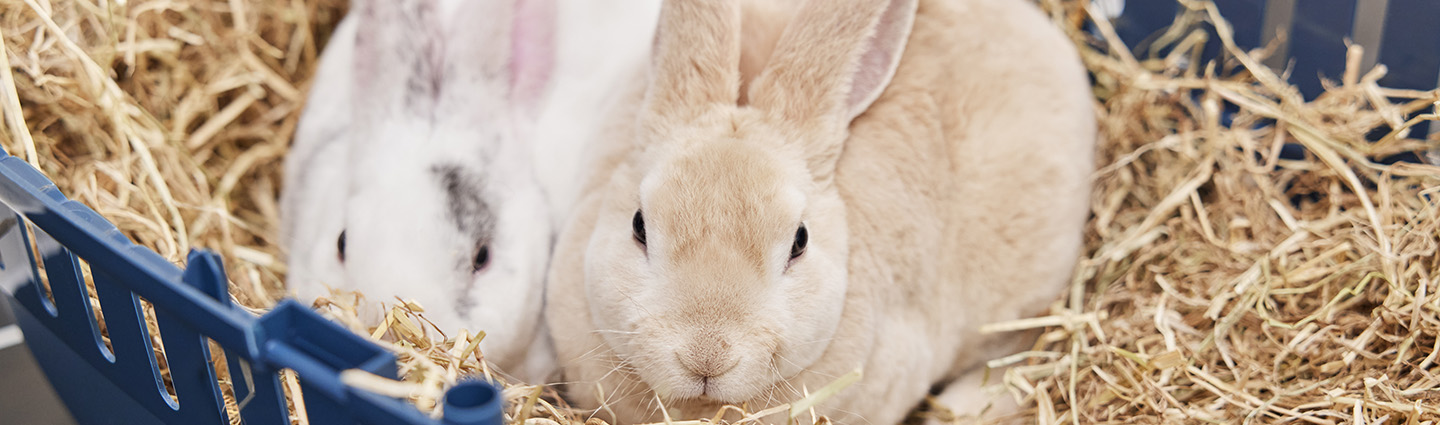
Rabbits need access to a large, safe and secure exercise area at all times. Most indoor rabbits either have a dedicated rabbit room, an enclosed part of a room or free access around the house. Keeping your pets in a safe, restricted area in the house is a good idea to prevent curious rabbits getting lost.
Supervision is essential, so they cannot get stuck or chew through things they shouldn’t. If a rabbit is determined to escape, then it will. Rabbits have been known to chew through stud walls and be found in a different room to the one they were left in.
Their enclosure should also feature a secluded space for their sleeping quarters. The sleeping quarters can be a hutch or a cage within the enclosure/room, with the doors left open to allow access in and out at any time.
Rabbits are social animals and should be kept in compatible neutered pairs. Providing hidey-holes, tunnels, platforms and toys, will enrich their home and they will enjoy exploring, playing and chasing each other around. It is also a great idea to include a burrow-box in their enclosure to satisfy the instinct to dig.
Rabbits love to chew. Your door frames and skirting boards, table and chair legs, soft furnishings and electrical cables will all be targets if your rabbit doesn’t have enough enrichment.
Chewing is a natural behaviour – it’s a way of wearing down their ever-growing teeth. Rabbits tend to dig to the base of the fibres of carpets and rugs and chew where the fibres come through the carpet backing – mimicking the way in which they eat grass.
It is thought that rabbits see electric cables as roots or branches and are the perfect width for rabbits to chew through. Electric cables must be moved out of reach of rabbits, put behind channelling or into a thick plastic tube to prevent your rabbit having any access.
Chewing and swallowing unsuitable materials, such as plaster, carpets and wallpaper, could cause serious intestinal problems and chewing electric cables can cause burns to the mouth or can be fatal.
Providing your rabbits with lots of toys and a variety of things to chew will reduce their urge to chew your fixtures and fittings. Why not try rotating their toys or chews or placing cardboard boxes or tubes with hay and forage inside around their enclosure? Branches from fruit trees are great for the rabbits to debark with their front teeth, and preferable to the varnished or painted wood in the house.
Why not bond with your pet rabbits, encourage playtime and protect your home with our whole range of toys for rabbits?
Your outdoor rabbits should have a hutch that is at least big enough for them to stand upon their back legs to full height and to lay down fully stretched out apart from each other. The length of the hutch should allow your rabbits to hop at least 3 times. This should be attached to a larger enclosure for exercise, exploring and play. Wooden hutches are usually best for insulation, with lots of clean, dry bedding inside.
Both hutch and run need to be secure, to prevent predators, and prevent rabbits escaping into unsafe areas. In the hutch, maintaining good ventilation without draughts is important for the rabbits, as is maintaining a dust-free, damp free, clean bedding area with extra bedding for insulation in colder weather.
In the run, there should be lots of enrichment items, such as perching spots, tunnels, toys, hidey-holes and things to chew. There will be digging opportunities and grass to nibble with a grass run, while patio runs benefit from a sand box and trays of turf to encourage natural behaviour.
Yes. Rabbits are a social species and need the company of other rabbits, wherever they are kept. Rabbits being kept together must all be neutered, with one male and one female usually making the most harmonious pair. Rabbits should never be kept with other species, such as guinea pigs, as they have different food requirements, different behaviours and different ways of communicating.
Neutering will prevent unwanted pregnancies and reduce fighting in pairs or groups of rabbits. It reduces the tendency for territorial behaviour – including spraying and other forms of scent marking. It is also advised to prevent reproductive system cancers in females. Neutering is always advised.
Contact your local veterinary surgery to discuss any questions you might have or to arrange an appointment.
As long as your rabbits have the following needs met, then they will have a good quality of life wherever they are living:
A suitable living environment: A large enough enclosure featuring a cosy place to sleep and plenty of space to exercise.
A suitable diet: Access to unlimited clean hay and water is essential, but their diet should be supplemented with the recommended daily intake of their favourite rabbit food as well as a portion of leafy greens and the occasional treat.
To be able to express natural behaviours: Such as playing, foraging, gnawing, enrichment toys will ensure your pet rabbit can engage and help to prevent behavioural issues.
To have companionship – Rabbits are social animals and shouldn’t be kept alone, companionship is vital for their well-being, preventing loneliness and stress.
To be protected from pain, injury, suffering and disease: The welfare of your pet is important.
If your rabbits have company of their own kind, suitable housing, protection from predators, a good diet and plenty of room for exercising, then they will be happy whether they are inside or out. If your house is particularly busy or has lots of noisy children or other pets, then your rabbits may appreciate the peace and quiet of living outside. But, if you can dedicate an area to the rabbits where they can retreat to and remain undisturbed when needed, then indoor living will keep them happy.
If you have a garden that is safe, then regular access to the outside can be very beneficial for indoor rabbits. They will enjoy the fresh air and access to growing grass and the opportunity to dig. The run must be safe against predators getting in, rabbits getting out and be free from poisonous plants. Rabbits adapt slowly to new conditions, so access outside should be started slowly and be regular all through the year, weather permitting.
Indoor rabbits need the same setup/conditions as those kept outdoors. They need hides, an exercise area and enrichment opportunities to help prevent boredom.
Once having settled in one environment, rabbits do not cope well with sudden changes, it's ok to move them from outdoors to indoors and vice versa, but any changes to their environment will need to be made gradually with careful monitoring.
Suddenly putting an indoor rabbit used to 20°C into a 2°C garden and leaving it for a couple of hours will not be good for its wellbeing. Rabbits need to become slowly acclimatised to cooler and warmer conditions, and their coat will change to accommodate this.
Remember that changing from indoor to outdoor means that the rabbits’ diet also changes. The rabbits’ gut takes a long time to adjust to new foods, so letting rabbits suddenly eat a large amount of grass in the spring when they are not used to it, will risk digestive upsets which can be severe. Keeping everything as consistent as possible throughout the year will keep your pets healthy and occupied.
Putting indoor rabbits in a run on the lawn for the first time can be a frightening time – there needs to be plenty of hiding places, maybe some familiar tunnels, hidey-holes or toys to help your rabbits to settle.
Coming indoors from outside reveals a host of new smells, surfaces (carpet, slippery floors), noises (vacuum cleaners, washing machines) and sights (flashing tv’s) and can be very overwhelming and provide chewing hazards.
If your rabbits are to be moved between inside and outside, there needs to be regular times spent indoors and outdoors. This ensures that changes in diet (grass, other plants, indoor forage) and temperature have less effect on your pets.
It is best to leave rabbits in the environment that they are used to, if it is safe to do so. As the temperature starts to change, your rabbits will develop a thicker, winter coat which will aid in shielding them from the worst of the weather.
However, if an extreme winter is forecast, or your rabbits are elderly or have an ongoing health condition, then it may be best to either move the rabbits into a shed, unused garage or indoors temporarily.
We have a variety of housing suitable as temporary accommodation for during extreme weather conditions or simply as sleeping spaces for indoor rabbits. Please note, it is important to ensure that the doors of temporary indoor cages are left open to allow access to a larger exercise space.
There are several risks when housing rabbits outside.
Rabbits are the normal prey of foxes, cats, bird of prey and sometimes badgers. The enclosures must be strong and secure to both keep these predators out and to keep your rabbits in.
Extra protection may be needed if the weather turns very cold, wet or windy. A tarpaulin can be used to partly cover the run and the hutch to give extra shelter, the hutch entrances must be shielded to prevent strong wind blowing bedding around and causing draughts. Removing snow from the top of the run will be necessary to prevent collapse, but snow will help insulate the hutch roof. In severe weather it may be necessary to relocate the rabbits into a shed or unused garage.
In the summer, shade must be provided, and the hutch moved out of direct sunlight. Rabbits do not tolerate heat well, especially if they are elderly, overweight or unwell so will need extra cooling measures taken in very hot weather. If your rabbit has a dirty bottom, then flystrike can happen within a few hours, so extra vigilance, daily monitoring and seasonal application of flystrike products from your vet are advised.
Care must be taken to check your rabbits regularly, even if the weather is bad. Twice daily checks are recommended, to make sure that your rabbits are fit and well, clean and have no early signs of illness. Regular contact with your rabbits is needed to keep the rabbit-human bond strong.
Rabbits can stay outside when it is raining if they have a sheltered area or hutch that they can use if they choose to. We offer a compatible hutch covers for all of our Pets at Home hutches. You can even cover part of their run with tarpaulin to give a drier area, preferably near the hutch, so the rabbits can continue to graze if they choose to. If your rabbits are very young, getting old or unwell, then it is advised to keep them dry to prevent them getting very wet or cold.
Some rabbits with very soft, fine or long coats, such as the rexes or angoras, have no or few guard hairs so the fur cannot block the rain as a normal coat does. They can get wet to the skin very quickly, so should be protected with a sheltered run (one or two sides as well as the top) or kept inside during the worst of the weather.
If your rabbits do get very wet, then bring them into a warm room and blot them dry with towels to help them warm up. Do not rub the rabbit as their skin is very thin and can tear easily. Offer them food and water and monitor them closely. If you do have concerns about their health after they have been soaked and gotten cold, then speak to your vet.
Keeping your rabbits’ housing clean will reduce any smell and reduce the risk of attracting flies, whether the rabbits live indoors or out. Litter trays or toileting areas should be cleaned daily, and any dirty bedding removed and replaced. Any urine marks should also be cleaned off using a rabbit safe disinfectant. The whole hutch/cage should be emptied and cleaned thoroughly every week with a rabbit safe disinfectant.