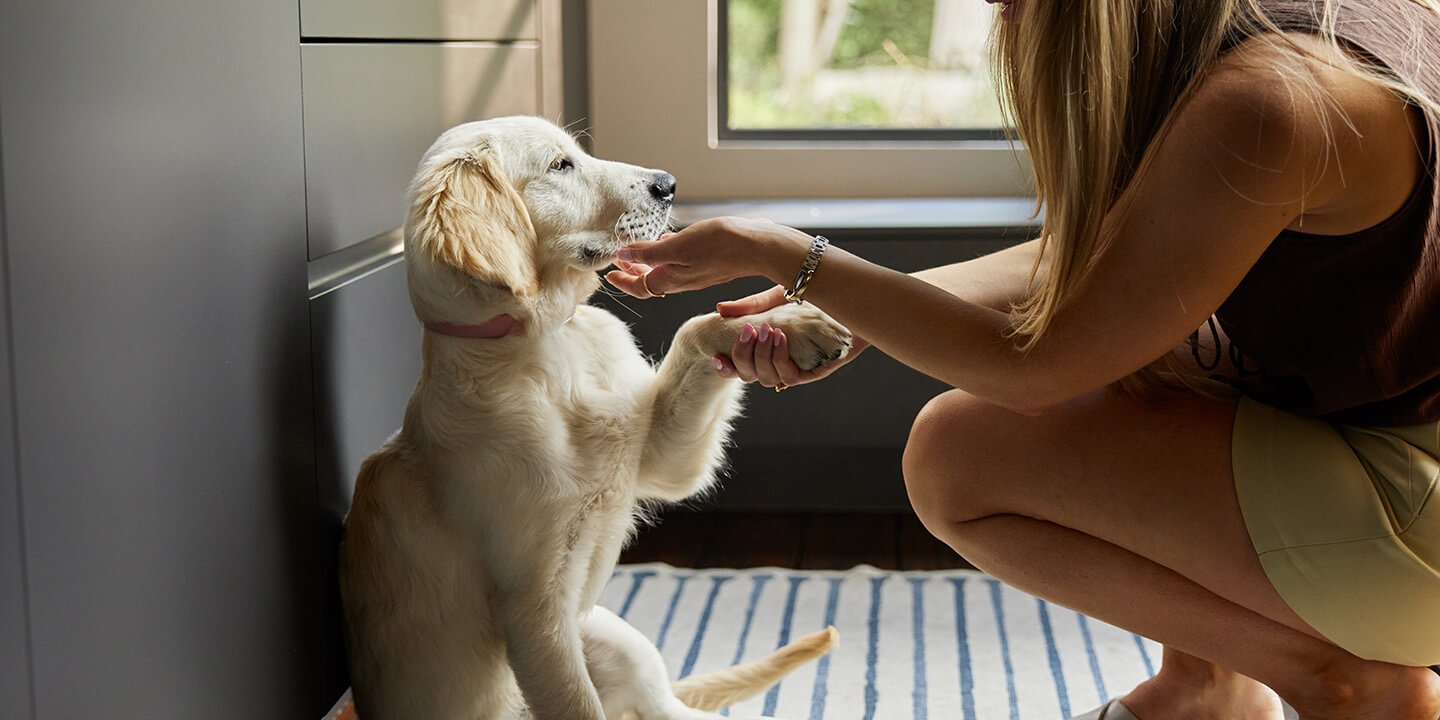
Bringing a new puppy home is exciting. From games of fetch to cuddles on the sofa, you and your pet have plenty of fun and adventure to look forward to together.
Of course, a great way to spend time together (and give your pet the exercise they need!) is to go on lots of interesting walks. While you may be looking forward to going adventuring with your pet, puppy walking starts with teaching them how to walk safely on a lead or harness. It might be commonly known that dogs love to go on walks, but your puppy won’t automatically know what to do when they go outside for the first time. It’s up to you to teach them the basics.
It is important that your puppy has finished their vaccination course before going outside onto public land. Vaccination courses for puppies start at 6-8 weeks, this is important as vaccination can help protect them against illnesses such as parvovirus. Your pup will take 1-2 weeks to develop full immunity after the last vaccination of the course, so can go out onto public ground after that. Your vet will outline the most appropriate vaccine schedule for your puppy.
Unvaccinated puppies should not be walked on the pavement or any other ground where the public exercise their dogs, as unknown dogs may not be vaccinated and could be carrying diseases. Exercise and socialising are very important for a young puppy, so before the vaccination course has finished, your puppy can be exercised in your enclosed garden.
Socialising with other dogs and humans is essential, so if you have friends or family that have vaccinated dogs, they can visit your puppy after the first vaccination has been given. Some puppy training courses take young puppies after their first vaccination, so they can meet and play with other puppies and their owners in a safe, clean environment.
Puppies can be carried to public areas to help with socialisation with people. People wanting to stroke can be very overwhelming for a young pup, so be firm if you feel pup has had enough. If your pup is trying to back away from the attention, then ask people to step back as pup just wants to watch from a distance.
The first thing you need to do is decide whether your puppy will wear a collar or a harness. If your puppy doesn’t like collars, then bear in mind that a lot of pet owners prefer harnesses over collars because they can help to ease the discomfort your pet might experience while they get used to walking on a lead. Some also find that harnesses can help to reduce pulling or breathing difficulties. Dogs can wear both a harness and collar, with the lead attached to the harness, but the collar also fitted to allow easier handling, this is particularly helpful in places like the vets.
Collars and harnesses should be correctly fitted. Collars need to be the correct tightness – too loose and they come straight off if the lead is pulled; too tight and they can rub the skin and make the dog uncomfortable. Harnesses need to be carefully fitted – the main strap underneath needs to sit just behind the forelegs and not on the tummy, there should be no areas that may rub around the forelegs and chest, and the harness should be adjusted so that it is neither too loose nor too tight. For help finding your perfect accessories, speak to one of our instore colleagues about our harness fitting service.
Lead training needs to be started at home so that your puppy will walk nicely on the lead on that first walk outside. Getting your puppy used to the feel of the collar or harness is the first job and can be started soon after your puppy comes home. The collar/harness should be put on for short periods of time only and your puppy rewarded with attention, affection and a treat or two before taking it off. This will make having a collar or harness on a positive experience for your puppy. Puppies should never be left unattended when getting used to the collar/harness in case they get caught on something or manage to get a leg caught.
Once puppy is tolerating the collar/harness well, then lead training can begin. In the house or garden, with favourite toy or treat in hand, allow puppy to wander about with no tension on the lead, then try and gently steer. Puppies will generally plant themselves down or pull back as soon as they feel tension in the lead, so relax the lead and then use vocal encouragement and the toy/treat to encourage pup to move forward with you. Dragging or forcing puppies to move will make them more reluctant to walk on the lead, so gentleness, encouragement and lots of patience are needed.
Taking your time with lead training, so that puppy will walk nicely next you, is the way to ensure that dog-walking over the years will be a pleasant experience for all concerned.
Historically, the general rule used for this is 5 minutes per month of age, once or twice daily. So, a 5-month-old dog would need 25 minutes exercise once or twice daily. Time spent is however proven to be less important than the type of exercise. High impact activities such as jumping, using stairs and exercising on slippery surfaces have more impact on joint health than the time spent alone. Take care to regulate your puppies exercise activities to prevent joint damage as they are growing.
Adult dogs can be maintained on 30 minutes once or twice daily, but many enjoy more. Large and giant breed dogs need to be restricted for longer, as they do not finish growing until they are 18-24 months old, so need low impact exercise in smaller amounts until they are mature.
Just as important as physical exercise are activities that keep your puppy or even adult dog’s brain busy. Playing training games with them in the garden or house can be just as satisfying for them as walks so consider mixing up their weekly routine.
If in doubt, ask your veterinary team for more advice on walking your puppy.
Exercising your puppy should be a mix of mental training and physical exercise. Your puppy cannot tell you when it is tired, so keeping to a set exercise time and routine is important to avoid overwalking. Overexercising will place undue amounts of strain on the developing bones and ligaments and may damage growth plates and joints, causing problems that will continue through their life. Make sure the exercise is low impact until your dog stops growing. Avoid the use of stairs, jumping and time spent on slippery surfaces.
A rough guide to puppy walks is to allow 5 mins for every month of age once or twice daily, so a 5-month-old puppy could be walked for 25 minutes once or twice daily. Adult dogs generally need 30 minutes once or twice daily, but many enjoy more than that. Large or giant breed puppies do not stop growing until they are 18-24 months, so need limited exercise for longer.
Playing with and training your puppy at home also stimulates their mind and will tire them mentally. If your puppy is playing or very excited, they can easily overtire themselves and so you should put them on lead or remove them from the situation for a rest at regular intervals.
Your vet can give you more advice on how to safely exercise your puppy.
On a walk, if your puppy starts to pant and slow down, then stop and allow them to rest for a while until they have recovered. If they start to overheat, your puppy will drool while panting heavily and can look confused or uncomfortable and could even vomit. Signs such as these must be taken seriously, the exercise stopped, and the puppy cooled down quickly. If the puppy looks poorly, then they should be taken directly to your vet.
Other signs of being over-exercised include stiffness or lameness, either on the walk, or when the pup wakes up after resting later. Ideally, pup should get home, have a bit of nap then wake up ready to go again. Little and often is much better for pup’s bones and joints then a long boisterous walk.
Puppies are excitable, boisterous and very energetic. Different breeds have different levels, but all puppies bounce with energy at times. Generally, most puppies will calm down a little once they have reached maturity, but the energy levels are generally high even then. Puppies need both mental and physical exercise to take the edge off their energy levels, so going on a sensible walk will use up some of pup’s energy.
Encouraging your puppy to be calm can help, making sure that there are quiet times set into the daily routine when your puppy can rest. Rewarding your puppy with a gentle, slow stroke when they are calm will give good attention for that state of mind and help your puppy to learn to be calm. Getting into a set daily routine will help your puppy to know when he is required to calm down and relax or when to get excited for walk, play or dinner.
- Wait until your puppy is fully vaccinated before taking them out on public ground
- Walk your puppy for 5 minutes per month of age, once or twice daily
- Keep to low impact exercise – games with balls or frisbees etc are high impact and can over-exercise the puppy and damage the joints/growth plates
- Running or cycling with your puppy should not start until they are at least 12 months old; agility and other high impact dog sports also don’t allow training until the dog is 1 year old
- Allow plenty of time for your puppy to sniff and investigate – this is good mental stimulation
- Closely monitor interactions with other dogs and intervene to stop play if your puppy becomes over-excited or the other dog is getting a bit rough or cross
- If starting to exercise off-lead, make sure that the area is secure, not too large and not packed with other dogs
- Enjoy being out with your puppy!